







 By
The Pretzel sex position is a side-entry position in which one partner lies on their side while the other kneels and straddles the lower leg. The upper leg is raised or bent toward the other partner, creating a close angle for face-to-face penetration. It is usually easier to control with slow, smaller movements than with large thrusts.
The position can feel relaxed and intimate because the partner lying down has a stable base while the kneeling partner controls much of the movement. The exact leg angle does not need to look like a picture; comfort, pelvic alignment, and freedom to change position matter more than reproducing one fixed shape.
What Is the Pretzel Sex Position?
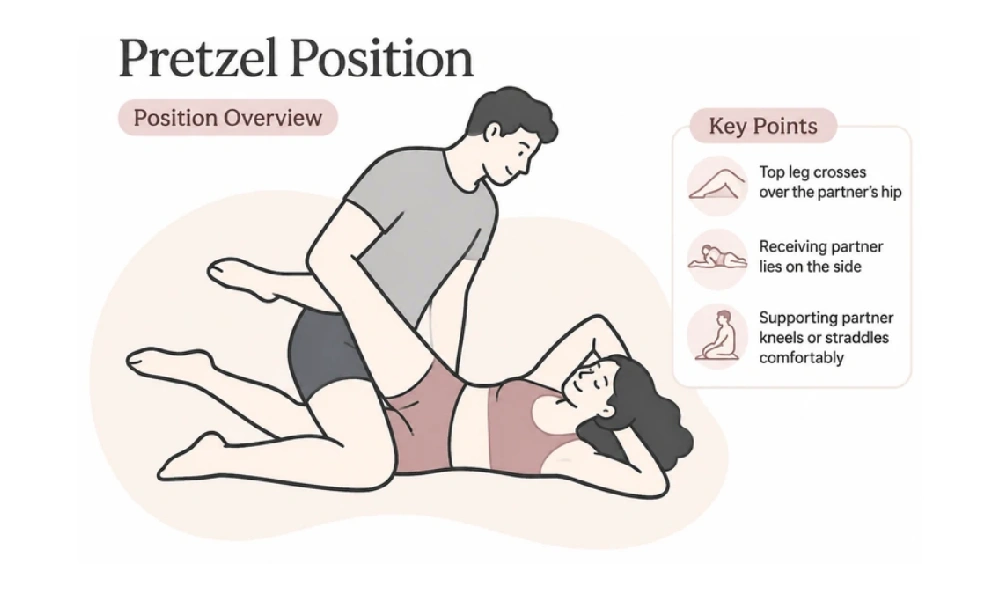
In the basic Pretzel position, one adult partner lies on their side while the other partner kneels and straddles the lower leg. The upper leg is lifted, bent, or brought toward the chest and may rest around the kneeling partner's body, depending on flexibility and comfort.
The position is sometimes described as a variation of side-entry sex because the bodies remain partly side-on rather than lining up in a conventional face-to-face position. The result is a combination of close body contact, a relatively stable lower partner, and a kneeling partner who can control the pace.
What Makes the Pretzel Different?
Pretzel is less about acrobatic flexibility than its name suggests. The lower partner can remain relatively relaxed, while the upper leg creates room around the pelvis without requiring both partners to support their full body weight.
It also leaves several ways to adjust the experience. A smaller leg lift can create a more relaxed setup, while changing the distance between the torsos can alter the pressure and penetration angle.
Is the Pretzel Position Good for Beginners?
It can be, particularly when the goal is a slower and relatively supported position. The key is to avoid treating the upper leg as something that must be pulled into a dramatic angle.
Beginners can start with the upper leg only slightly raised, confirm that both partners can move freely, and then make small adjustments. A position that feels natural with a lower leg angle is generally more useful than an exact pose that causes strain. If you'd like to explore other options, browse our guide to different sex positions for couples and find a setup that feels right for both of you.
How to Do the Pretzel Sex Position Step by Step
The simplest way to set up the Pretzel is to get comfortable on your side first. Once you're settled, your partner can kneel beside you and adjust the position until everything feels natural.
Prefer exploring on your own? A realistic full-size sex doll lets you try different positions, including the Pretzel, at your own pace and in the comfort of your own space.
For Your Personal Moments
Discover our selection of realistic TPE sex dolls, with lifelike details and different styles to suit your preferences.
 Realistic TPE Full Size Sex Doll
Featuring a realistic full-size design and brown wavy hair, this TPE sex doll is an option for adults interested in a more lifelike appearance. Its full-size format offers a different experience from compact novelty products.
View Realistic TPE Full Size Sex Doll Seductive Wave Goddess Sex Doll
The Seductive Wave Goddess combines a lifelike TPE design with a distinctive adult doll appearance. It is another option for shoppers who prefer a full-size doll rather than smaller personal accessories.
View Seductive Wave Goddess Sex Doll VenusFun Sola C-Cup Life Size Sex Doll
The VenusFun Sola features a life-size design with a C-cup figure. It offers another style for adults who prefer a more substantial doll format and a distinctive body design.
View VenusFun Sola C-Cup Sex Doll- 22% OFF eligible sex doll orders of $199+
- 25% OFF eligible sex doll orders of $499+
Step 1: Lie on Your Side
Stable base Beginner-friendlyThe receiving partner lies on their side on a stable bed or other comfortable surface. The lower leg can remain fairly straight or bend slightly if that takes pressure off the knee or hip.
Keep the lower arm wherever it feels natural. The goal at this stage is simply to create a stable base that does not require the lower partner to hold their body up with their arms.
Step 2: Position the Upper Leg
Adjustable Hip comfortBend or raise the upper leg toward the chest until the hip feels comfortable. The leg can remain moderately bent instead of being pulled tightly upward.
If the leg starts to feel stretched at the hip or knee, lower it slightly. The upper leg is there to create access and positioning room, not to test flexibility.
Step 3: Kneel Over the Lower Leg
Top partner Balance firstThe other partner kneels and straddles the lower leg while keeping their torso upright or slightly forward. Their knees should have a secure base on the mattress rather than relying on the receiving partner's body for balance.
Move close enough for comfortable contact, but leave enough space to make small adjustments. If either partner feels unstable before any movement begins, reposition first.
Step 4: Align the Pelvises
Alignment firstIf penetration is part of the activity, line up the pelvises before adding movement. The kneeling partner can move slightly closer or farther away, while the receiving partner can change the height of the upper leg.
Do not use force to correct a poor angle. Small changes in leg height, torso position, and body distance can make a substantial difference.
Step 5: Establish a Comfortable Hold
Support CommunicationThe kneeling partner can place their hands on the bed, the receiving partner's waist, or their leg, depending on what provides the best balance. The receiving partner can keep the upper arm in front, behind the body, or around the other partner.
A handhold should help with stability rather than pulling the raised leg into a deeper position. Both partners should be able to release their hold quickly if the angle becomes uncomfortable.
Step 6: Start With Small Movement
Slow start Controlled rhythmBegin with slow, shallow movement and pay attention to how the hips and raised leg respond. Shorter movements make it easier to maintain alignment and change position quickly.
Once both partners are comfortable, the kneeling partner can gradually change rhythm or pressure. There is no need to increase speed simply because the position allows a more active partner to do so.
How to Make the Pretzel Position More Comfortable
The biggest difference between a comfortable Pretzel and an awkward one is usually the angle of the upper leg. A higher leg position can change the pelvic angle, but higher is not automatically better.
Keep the Upper Leg Relaxed
Avoid holding the raised leg with unnecessary muscular effort. If the hip starts to tire, lower the leg slightly or allow the knee to move closer to a natural resting position.
The other partner can support the leg gently if needed, but should not pull it farther toward the chest without checking that the movement feels comfortable.
Adjust Body Distance Before Changing Speed
When penetration feels too deep, too shallow, or poorly aligned, changing the distance between the torsos is often more useful than moving faster or harder. Move the bodies a few centimeters at a time and reassess.
If a particular angle repeatedly creates discomfort, return to a neutral setup instead of trying to push through it.
Use a Pillow for Comfort, Not Force
A firm pillow can provide support under the head, upper body, or another area that needs gentle elevation. It should make the position easier to hold, not force the pelvis or legs into a more extreme angle.
Avoid unstable stacks of loose pillows. If a support shifts as the partners move, remove it and use a more stable surface.
Keep the Kneeling Partner Stable
The kneeling partner should have enough mattress space to keep both knees securely supported. If the knees are slipping or the body is leaning too far forward, adjust the position before continuing.
Pretzel Variations for Different Bodies and Flexibility Levels
There is no single correct Pretzel shape. Body proportions, hip mobility, mattress firmness, and height differences can all change how the position needs to be arranged.
Lower-Leg Pretzel
Keep the upper leg only slightly bent instead of bringing it close to the chest. This is a useful starting point when the traditional raised-leg version creates too much hip tension.
The kneeling partner can remain more upright and make smaller movements while the lower partner stays relaxed on their side.
Supported Upper Leg
The raised leg can rest against the other partner's body or on a stable part of the mattress rather than being held in the air continuously. This can reduce muscular fatigue during a longer session.
Do not use a soft object that can suddenly collapse underneath the leg. The support should remain stable when body weight shifts.
More Upright Pretzel
The kneeling partner can keep the torso more upright while the receiving partner keeps the upper leg moderately raised. This gives the top partner more freedom to use their hands for balance or touch.
It can also reduce the amount of forward pressure on the lower partner, although the best angle depends on individual body proportions.
Height Difference
A noticeable height difference does not automatically rule out the Pretzel position. The important factor is whether the kneeling partner can reach a stable position while the pelvises remain comfortably aligned.
If the height difference makes the angle awkward, change the receiving partner's leg position first. Raising the upper leg slightly or lowering it can be more effective than trying to change the entire body posture.
Limited Hip or Knee Flexibility
Keep the upper leg lower and allow the lower leg to bend naturally. There is no need to force the knees together or pull the thigh toward the chest.
If a healthcare professional has given you movement restrictions because of an injury or medical condition, stay within those limits rather than using the position as a flexibility exercise.
Common Pretzel Position Problems and Practical Fixes
Most problems can be addressed by reducing the range of motion and changing the leg or pelvic angle. Use the table below as a quick troubleshooting guide.
| Problem | Common Reason | Try This | When to Stop |
|---|---|---|---|
| Upper leg feels strained | The thigh is being held too close to the chest. | Lower the leg slightly and let the knee bend naturally. | Stop for sharp or increasing hip or knee pain. |
| Too much penetration pressure | The pelvis angle or body distance is creating excessive depth. | Lower the raised leg, move the bodies slightly apart, and reduce movement range. | Stop for sharp or persistent pain. |
| Hard to maintain balance | The kneeling partner does not have a stable knee or hand position. | Widen the knee base and use the mattress or a stable surface for support. | Stop if either partner feels at risk of falling. |
| Lower back feels tired | The receiving partner is twisting or holding the torso rigidly. | Adjust the side-lying posture and add comfortable head or back support. | Stop if fatigue becomes painful. |
| Movement keeps slipping | The bodies are separating too far or the movement range is too large. | Move closer and use shorter, slower movements. | Pause if repeated slipping causes discomfort. |
| Too much friction | Dryness or repeated contact at one angle. | Slow down, reposition, and use compatible lubricant if appropriate. | Stop for burning, tearing sensations, or persistent pain. |
| Leg becomes numb | Pressure is being maintained in one position for too long. | Lower the leg, change position, and allow normal sensation to return. | Do not continue through persistent numbness or tingling. |
When to Choose Another Position
Pretzel is not a flexibility test, and there is no reason to force it if the leg, hip, knee, or lower back never becomes comfortable. A different side-lying or face-to-face position may provide similar intimacy with less joint strain.
VenusFun's sex positions guide includes additional options for couples who prefer more supported or lower-effort setups.
Pleasure, Lubricant, and Useful Extras for the Pretzel
The Pretzel position does not guarantee a particular sensation or orgasm. Its practical advantage is that the lower partner can remain relatively relaxed while the upper partner has room to control rhythm, angle, and pressure.
External Stimulation
The side-entry arrangement can leave one hand available for external stimulation, depending on how the partners position their arms and legs. For some people with a vulva, adding direct external stimulation may be more useful than changing penetration depth.
A compact external vibrator can also be used if there is enough space and both partners are comfortable with it. Keep the device away from areas where it could interfere with balance or create uncomfortable pressure.
Does the Pretzel Position Provide Deeper Penetration?
The Pretzel can create a different penetration angle and may feel deeper for some people, but depth varies considerably with anatomy and positioning. Raising the upper leg does not guarantee more pleasure, and a deeper angle can be uncomfortable for some bodies.
If deeper penetration feels uncomfortable, lower the upper leg, reduce the movement range, or increase the distance between the pelvises. Comfort should determine the final angle rather than a goal of maximum depth.
When Lubricant Helps
Repeated movement can create friction, particularly when the partners stay in the same angle for a while. Lubricant can reduce unwanted friction and make smaller movements feel smoother.
A water-based formula is a straightforward choice for many couples. VenusFun's personal lubricant guide explains water-based, silicone-based, and oil-based formulas and common compatibility considerations.
Choose Extras Based on the Actual Problem
Lubricant has the clearest functional role when friction is the issue. Barrier protection belongs in the setup when it is part of your safer-sex plan, while novelty products are optional and should not be treated as necessary equipment for the Pretzel.
If the problem is an awkward angle, change the body position first. If the problem is friction, consider lubricant; if the issue is joint pressure or fatigue, lower the raised leg, improve support, or change positions.
Consent, Protection, and Pretzel Position Safety
The Pretzel position is not inherently unsafe, but the raised-leg setup can create unnecessary pressure if either partner tries to hold an extreme angle. Both people should be able to loosen the position, change the leg angle, or stop without difficulty.
Pain and Numbness Are Reasons to Reposition
Muscle fatigue can happen during any sustained position, but sharp pain should not be treated as something to work through. Numbness, tingling, cramping, or increasing pressure around the hip or knee are also reasons to lower the leg and change position.
Anyone with an injury, recent surgery, or movement restrictions from a healthcare professional should stay within those restrictions rather than forcing the leg into a particular Pretzel shape.
A comfortable sex position should remain adjustable. Do not pull a partner's leg farther than they can comfortably move, and do not continue penetration through significant or persistent pain.
Consent Continues Throughout the Position
Agreeing to the Pretzel position does not automatically mean agreeing to every speed, depth, penetration type, toy, or change in activity. Check in when changing the angle or introducing something new.
The receiving partner may have less freedom to move because they are lying on their side, so both partners should keep communication easy and make sure either person can ask to pause or reposition at any time.
Condoms and STI Protection
The Pretzel position does not reduce STI risk by itself. If condoms are part of your safer-sex plan, use them correctly and consistently during relevant sexual contact.
The CDC's condom-use guidance explains correct external condom use and notes that condoms reduce, but do not eliminate, STI risk when used correctly and consistently.
Follow the condom manufacturer's lubricant-compatibility instructions. When appropriate, a compatible lubricant can help reduce friction and the chance of irritation or condom failure caused by excessive dryness.
Pregnancy Risk Does Not Depend on the Position
Sitting, lying on the side, or changing the penetration angle does not make penis-in-vagina sex contraceptive. Pregnancy remains possible when sperm enters the vagina regardless of the sexual position.
If avoiding pregnancy matters, use a contraceptive method appropriate for your circumstances. The CDC overview of contraception covers established birth-control options.
Take Extra Care With Anal Penetration
The Pretzel position can be adapted for anal penetration, but the position does not remove the need for gradual movement, adequate lubrication, and clear communication. Stop for sharp or persistent pain rather than trying to push through it.
Before moving a penis or insertive toy from anal contact to vaginal contact, use a new condom or clean the toy appropriately first. This helps reduce the transfer of bacteria between areas.
FAQ About the Pretzel Sex Position
Is the Pretzel sex position good for beginners?
Yes, it can be. Start with the upper leg only slightly raised, keep the lower partner comfortably supported on their side, and use slow, small movements. The leg does not need to be pulled tightly toward the chest.
Does the upper leg have to be raised very high?
No. A modest bend or lift is enough to create the basic position. Lowering the leg can actually make the position more comfortable when the hip or knee feels strained.
Why does the Pretzel position feel too deep?
The pelvic angle and raised-leg position can change penetration depth. Lower the upper leg, move the bodies slightly apart, and reduce the movement range. Deeper penetration is not necessarily more comfortable or pleasurable.
Can the Pretzel position work for different body types?
Usually, yes. The position is adjustable, so partners can change the upper-leg angle, knee position, torso distance, and pelvic alignment. The goal is a stable setup rather than matching a particular illustration.
Can the Pretzel position be intimate as well as penetrative?
Yes. The side-facing setup allows close body contact, kissing, touching, and conversation. It can also be used with slower rocking or grinding rather than focusing on penetration depth or speed.
Does the Pretzel position reduce pregnancy or STI risk?
No. Sexual position does not provide contraception or STI protection. Use appropriate contraception and safer-sex barriers when relevant, regardless of whether sex happens on the side, sitting, standing, or lying down.










comments