


.webp)
.jpg)
.webp)



 By
By
If you are wondering why it burns when you pee after sex, the cause may be as simple as friction, dryness, or irritation from a condom, lubricant, or soap. Burning that lasts, keeps returning, or comes with urinary urgency, unusual discharge, blood, fever, pelvic pain, or back pain is more likely to need professional evaluation.
The most useful clues are where the burning feels, when it starts, how long it lasts, and what other symptoms appear with it. Those clues cannot confirm a diagnosis, but they can help you decide whether to rest and observe or arrange testing.
What the Timing and Location of the Burning Can Tell You
“Burning after sex” can describe two different sensations. One happens when urine touches irritated skin around the vulva, vaginal opening, penis, foreskin, or urethral opening. The other feels as though the burning is coming from inside the urinary passage.
It Stings on the Outside
This often feels sharp when urine first touches the skin, then settles after you finish peeing. The area may also feel tender during wiping, washing, walking, or touch.
Friction, limited lubrication, prolonged penetration, shaving irritation, menstrual products, or a new intimate product may be involved.
It Burns Inside the Urethra
Internal burning may continue through the urine stream or remain afterward. Urgency, frequent urination, discharge, difficulty urinating, or lower abdominal discomfort can appear at the same time.
A urinary tract infection, urethral inflammation, an STI, or another urinary problem may need to be ruled out.
When It Burns Once and Then Goes Away
If it burns to pee after sex but goes away after one or two bathroom trips, temporary surface irritation is one possibility. This is especially plausible when sex was longer or rougher than usual, lubrication was limited, or the genital skin already felt tender.
Improvement is reassuring, but it is not a perfect test. Watch for symptoms that return later, because urinary or urethral irritation may become more noticeable over several hours.
When the Burning Starts Later
Burning that begins the next morning or becomes stronger over time is less typical of a simple momentary sting. Pay attention to whether you also need to pee more often, pass only small amounts, notice cloudy or bloody urine, or develop lower abdominal discomfort.
Timing alone cannot separate a UTI from an STI or another cause. It becomes useful only when combined with the location and the rest of the symptoms.
Common Reasons Peeing Burns After Sex
Friction, Dryness, or a Longer Session
Genital tissue can become sore after repeated penetration, vigorous movement, limited arousal, or too little lubricant. Small abrasions are not always visible, but urine can sting when it touches them.
This can happen during first-time sex, after a break from penetration, during hormonal dryness, or whenever movement starts to feel draggy. Pain is a reason to pause, add compatible lubricant, change the activity, or stop rather than push through.
ACOG explains that lubricants can reduce discomfort during intercourse when vaginal dryness is involved. Its guidance also distinguishes lubricants used during sex from vaginal moisturizers used for ongoing dryness. Read ACOG’s guidance on vaginal dryness and lubricants.
A New Condom, Lubricant, Spermicide, or Soap
Latex, spermicide, fragrance, flavor, warming ingredients, cooling ingredients, preservatives, or strongly scented cleansers may irritate sensitive skin. The reaction may involve burning, itching, redness, swelling, or a raw feeling rather than urinary urgency.
Think back to anything that changed during the encounter. A new condom brand, flavored lube, massage oil, wipe, body wash, bath product, or laundry detergent may be more relevant than the sexual activity itself.
A Urinary Tract Infection
Sexual activity can move bacteria closer to the urethral opening, although a UTI is not an STI and can occur without sex. Common clues include burning during urination, strong or frequent urges to pee, lower abdominal discomfort, and urine that looks cloudy, bloody, or unusually strong-smelling.
These symptoms cannot be confirmed at home by appearance alone. The NIDDK guide to bladder-infection symptoms explains the common signs and the symptoms that may suggest the infection has moved beyond the bladder.
An STI or Urethral Inflammation
Chlamydia, gonorrhea, trichomoniasis, herpes, and other infections can cause painful urination. Depending on the infection, there may also be vaginal or penile discharge, sores, genital itching, bleeding between periods, testicular discomfort, or pain during sex.
The absence of discharge does not completely rule out an STI because some infections cause mild symptoms or no obvious symptoms. Testing is more useful than guessing when there has been condomless contact, a new partner, a partner with symptoms, or uncertainty about recent testing.
The CDC’s information about chlamydia lists burning during urination as a possible symptom in both women and men and explains that the infection may also be present without noticeable symptoms.
Vaginal, Vulvar, Penile, or Foreskin Irritation
Inflamed genital skin can make urination painful even when the bladder is not the source. Dryness, dermatitis, yeast-like irritation, balanitis, shaving, tight clothing, repeated wiping, or an existing skin condition may all contribute.
Itching, visible redness, cracked skin, odor, or a change in discharge suggests that more than friction may be involved. Avoid applying multiple over-the-counter products at once, since that can worsen irritation and obscure the original cause.
How to Read the Other Symptoms
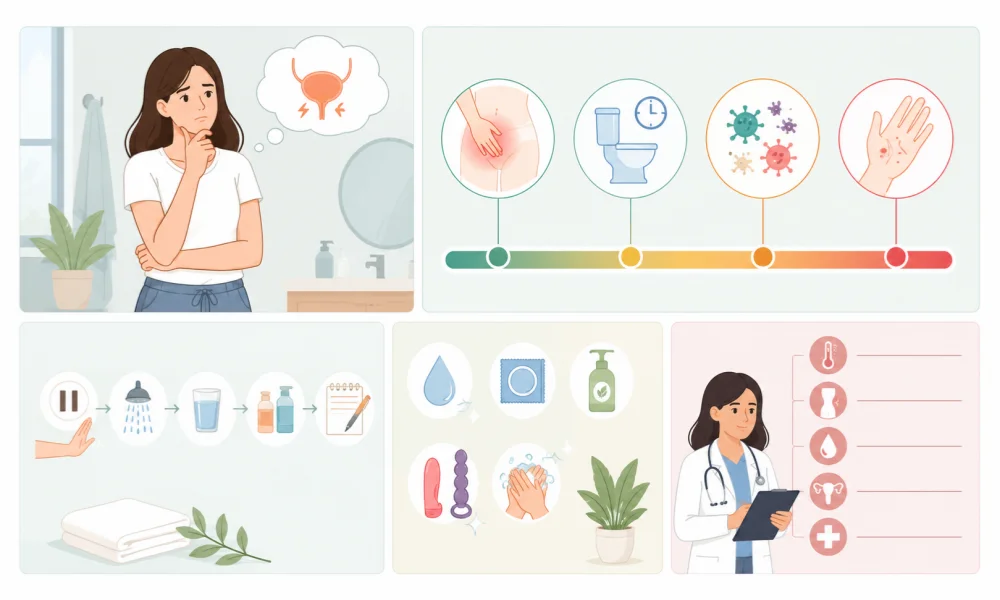
No symptom combination can diagnose the cause with certainty, but patterns can help you choose a sensible next step. Use the table as a guide rather than a self-diagnosis checklist.
| What You Notice | What It May Fit | A Sensible Next Step |
|---|---|---|
| Immediate external sting that fades quickly | Friction, dryness, shaving irritation, or urine touching a small abrasion | Pause penetration, rinse externally with lukewarm water, and watch whether it fully settles |
| Burning with urgency or frequent small urinations | A UTI or other urinary irritation | Arrange a urine assessment, especially if symptoms continue or worsen |
| Burning with unusual vaginal or penile discharge | An STI, urethritis, vaginitis, or another genital infection | Avoid sex and arrange appropriate testing |
| Burning with itching, redness, or swelling | Product irritation, latex sensitivity, dermatitis, or genital inflammation | Stop new products and seek advice if symptoms are strong or do not improve |
| Burning with spotting or bleeding | Friction, menstruation, cervical or vaginal irritation, or blood in the urine | Identify where the blood is coming from; unexplained, repeated, or heavy bleeding needs evaluation |
| Burning with fever, chills, vomiting, or side or back pain | A urinary infection that may have moved beyond the bladder or another acute problem | Seek urgent medical care |
| Symptoms after nearly every sexual encounter | Recurring UTI, repeated friction, product sensitivity, dryness, pelvic-floor pain, or another ongoing condition | Keep a symptom and product record and discuss the recurring pattern with a clinician |
What If It Burns but There Is No STI?
A negative STI test does not mean the discomfort is imaginary, and an STI is far from the only explanation. Friction, a UTI, product irritation, skin inflammation, hormonal dryness, and noninfectious urethral irritation can all cause similar burning.
Testing also reflects what was tested and when. If exposure was recent or symptoms continue, a healthcare professional can advise whether repeat or additional testing makes sense.
What If There Is Bleeding Too?
First work out whether the blood appears to be in the urine, from the vagina, from menstruation, or from a visible external abrasion. A tiny smear after friction is different from red or brown urine, repeated bleeding after sex, or bleeding accompanied by significant pain.
Do not assume bleeding is normal simply because sex was vigorous or it was your first time. Heavy bleeding, blood in the urine, pregnancy-related bleeding, or bleeding that returns needs prompt professional advice.
What to Do Right Now
Mild irritation may settle with rest, but the goal is to reduce further friction and observe the pattern. These steps are appropriate while symptoms are mild and no urgent warning signs are present.
- Pause Penetration and Toy Use Give irritated tissue time to recover. Continuing can reopen sore skin and make the next urination more painful.
- Rinse the Outside Gently Use lukewarm water on external genital skin. Do not douche or wash inside the vagina or urethra.
- Drink Normally Stay hydrated so urine is not highly concentrated, but do not force extreme amounts of water. Excessive drinking does not treat an infection.
- Stop Newly Introduced Products Set aside new lubricants, condoms, spermicides, wipes, washes, massage oils, or fragranced products until the cause is clearer.
- Watch the Next Few Bathroom Trips Note whether the discomfort is fading, staying the same, or becoming stronger. Also watch for urgency, frequency, discharge, blood, sores, fever, or pelvic pain.
- Arrange Care When the Pattern Is Not Settling Symptoms that last into the next day, return repeatedly, or come with other warning signs should not be managed only with home care.
Women, Men, Pregnancy, Periods, and First-Time Sex
Why Does It Hurt to Pee After Sex for Women?
For women, the urethral opening sits close to the vagina and anus, so friction and bacterial movement during sex can affect the area around it. Urine may also sting the vulva or vaginal opening when the tissue is dry, rubbed, or slightly abraded.
Burning with urinary urgency or frequency points more toward the urinary tract than a simple external scrape. Burning with itching, redness, vaginal soreness, or a change in discharge may fit vulvar or vaginal irritation instead.
Why Does It Burn When Men Pee After Sex?
In men, brief burning may follow vigorous friction, limited lubrication, condom sensitivity, or irritation at the urethral opening. Internal urethral inflammation can also cause burning even when there is no obvious external redness.
Penile discharge, sores, testicular pain, difficulty urinating, fever, or pain during ejaculation should not be dismissed as normal post-sex soreness. These symptoms are reasons to arrange an examination and appropriate testing.
Why Does It Burn While Pregnant?
Pregnancy can change urinary habits and makes prompt assessment of possible urinary infection more important. New burning during urination in pregnancy should be discussed with an obstetric or pregnancy-care professional rather than observed for several days without advice.
ACOG describes UTIs as a relatively common pregnancy complication and explains why recognizing and treating them matters. Its clinical guidance on urinary tract infections in pregnancy provides further detail.
Seek faster help if the burning comes with fever, back or side pain, abdominal pain, bleeding, contractions, vomiting, or feeling generally unwell.
Why Does It Burn During a Period?
Period blood itself does not usually explain internal urinary burning. However, pads, liners, tampons, frequent wiping, hormonal dryness, longer moisture exposure, or sex when the tissue is already sensitive may increase external irritation.
Menstruation can also make it harder to identify where blood is coming from. If the discomfort feels internal, continues after the period, or comes with urinary urgency or fever, do not assume menstruation is the cause.
Why Does It Burn After Sex for the First Time?
First-time penetration can involve unfamiliar pressure, muscle tension, limited arousal, or insufficient lubricant. Temporary external soreness is possible, but severe pain, ongoing urinary burning, significant bleeding, or pain that makes penetration impossible is not something to push through.
More time, communication, gradual touch, and adequate lubricant may help during a future attempt. The activity should stop whenever the body remains tense or pain is increasing.
How to Lower the Chance of It Happening Again
Prevention depends on the cause. A strategy that reduces friction will not prevent every UTI or STI, but comfortable technique and careful product use can remove several avoidable triggers.
- Allow enough time for arousal before penetration.
- Use enough lubricant and reapply before movement begins to drag.
- Choose fragrance-free products when genital skin reacts easily.
- Check that the lubricant is compatible with the condom and toy material being used.
- Stop when an activity starts to burn rather than trying to continue through it.
- Wash hands and clean reusable toys according to the manufacturer’s instructions.
- Use a new condom or fully clean a compatible toy before moving from anal use to vaginal use.
- Use a fresh barrier on shared toys, especially when the material is porous or difficult to disinfect.
- Avoid fragranced wipes, deodorizing sprays, douches, and harsh soap on genital tissue.
- Consider urinating after sex, but do not treat it as guaranteed protection against a UTI.
If dryness or product sensitivity seems likely, the VenusFun guide to choosing lube for sensitive skin explains how water-based, silicone-based, fragranced, flavored, and sensation formulas differ. The goal is not to find the strongest or slickest formula, but one that fits your body, condoms, toys, and type of play.
Someone who wants a straightforward formula can also review the ingredient and compatibility details for Sliquid Naturals H2O water-based lubricant. This is included as an example of a plain water-based option to compare, not as a treatment for urinary pain or infection.
When to Get Medical Advice
Arrange a medical appointment if burning lasts into the next day, returns after several sexual encounters, or repeatedly interrupts sex. It is also sensible to seek testing after a new or possible STI exposure, even when discharge or sores are absent.
- Burning that persists, worsens, or keeps returning
- A frequent or urgent need to urinate
- Cloudy, strong-smelling, pink, red, or brown urine
- Unusual vaginal or penile discharge
- Genital sores, blisters, swelling, or a spreading rash
- Bleeding after sex that is unexplained or recurrent
- Possible STI exposure
- New urinary pain during pregnancy
- Pain during ejaculation or testicular discomfort
- Fever or chills with painful urination
- Vomiting or feeling seriously unwell
- Strong pain in the back, side, pelvis, or lower abdomen
- Severe testicular pain or swelling
- An inability to urinate
- Heavy bleeding or clearly visible blood in the urine
A clinician may suggest a urine test, STI testing, an external or pelvic examination, or another assessment based on the symptom pattern. That is more reliable than trying several treatments at once and hoping one happens to work.
Until the area feels normal again, avoid the activity or product that seems to trigger the burning. If symptoms return after recovery, treat the recurrence as useful information rather than something you need to tolerate.
FAQ About Burning When You Pee After Sex
Why does it burn when I pee after sex but then go away?
A brief sting that starts immediately after sex and fades may come from friction, dryness, or urine touching irritated external skin. It is less reassuring if the burning returns, lasts into the next day, or comes with urgency, discharge, blood, pelvic pain, or fever.
Why does it burn after sex if I do not have an STI?
STIs are only one possible cause. Dryness, vigorous penetration, a new lubricant, latex, spermicide, fragranced soap, a urinary tract infection, or noninfectious urethral irritation can also cause burning. Symptoms alone cannot always identify the cause.
Why does it hurt to pee after sex for women?
For women, urine may sting irritated vulvar or vaginal-opening tissue after friction, and bacteria can also reach the nearby urethra during sexual activity. Burning with urinary urgency, frequency, lower abdominal discomfort, or cloudy or bloody urine should be checked.
Why does it burn when men pee after sex?
In men, burning can follow friction, condom or lubricant irritation, or inflammation inside the urethra. Persistent burning, penile discharge, sores, testicular pain, fever, difficulty urinating, or pain during ejaculation should be assessed by a healthcare professional.
Can a period or first-time sex cause burning when I pee?
Yes. Friction, limited lubrication, menstrual-product irritation, or small external abrasions can make urine sting. These situations do not explain severe pain, significant bleeding, urinary urgency, fever, unusual discharge, or burning that keeps returning.
Should I have sex again while it still burns?
Wait until the area feels comfortable and urination no longer burns. More penetration can reopen irritated tissue and make it harder to tell whether symptoms are improving. Recurrent or persistent symptoms should be checked before resuming activities that trigger them.










comments